Before dawn, a lantern moves through an empty cemetery. Surveyor Mara Keene follows it, certain that a measurement can separate a story from the truth. Then she opens the map.
On YouTube: She Followed a Lantern Through an Empty Cemetery. The Map Made It Worse.
Fiction inspired by the Lawson Mine disaster and Black Diamond Cemetery folklore. Mara Keene, Cal Rourke, June Miller, and their encounters are fictional. The opening artwork is a cinematic illustration, not a historical photograph.
Behind the story / Case file 03
Black Diamond Cemetery.
The people, the disaster, and the later stories.
The Record · A mining community
The people the cemetery remembers
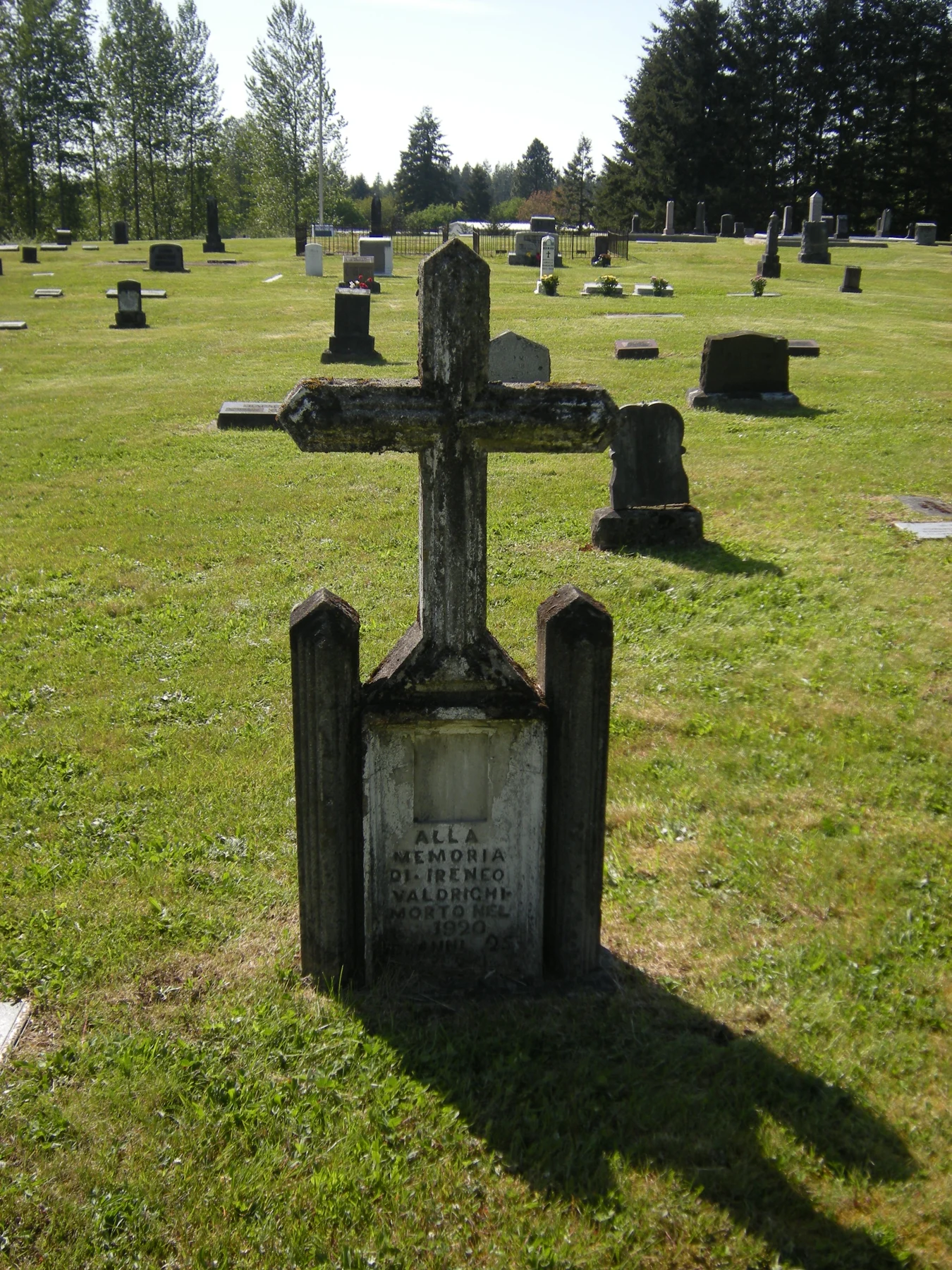
Black Diamond Cemetery · May 21, 2009 · Joe Mabel. Source · CC BY-SA 3.0. Resized and converted to WebP; adapted image under the same license. A location photograph, not a depiction of the disaster or an identification of Lunden’s grave.
Black Diamond Cemetery stands at 24431 Morgan Street in Black Diamond, King County, Washington. The city dates its founding to 1884. Its graves preserve the history of a community built around coal mining.
The National Register nomination describes a surviving record of industrial, immigrant, and community life. Inscriptions reflect a diverse workforce; individual graves record the human cost of mining. Cemetery maintenance was once supported by deductions from miners’ wages.
The Black Diamond Historical Society’s Fall 2024 account places the explosion at 6:40 a.m. Eleven men were descending and five night-shift workers remained below. Sixteen men died; five bodies were never recovered. Eight victims were subsequently buried together at Black Diamond Cemetery.
The account reproduces the coroner’s jury finding that the men died by explosion, “cause unknown, according to the evidence before the jury.” Several physical explanations were proposed. The uncertainty concerns the disaster’s mechanism; it provides no evidence of a supernatural cause.
Black Diamond Historical Society, Fall 2024 newsletter: Lawson mining history, the disaster, and the inquest.
The Record · One documented life
Dave Lunden
Dave Lunden was a Finnish fire boss killed in the Lawson Mine disaster. The historical society’s October 2010 newsletter summarizes a probate file under the name Davit Albein Lunden. It describes an unmarried Black Diamond resident, a member of the United Finnish Brotherhood of the World, with a father in Finland and a seafaring brother sailing out of New York.
His age differs between records: the reproduced mine inspector’s list gives 34; the probate summary gives 35. These records preserve a person with family, work, and community ties. The sources reviewed do not reliably identify him as the cemetery’s alleged lantern bearer.
An Enumclaw Courier-Herald article originally published April 17, 2002, records stories of swinging lanterns on foggy nights, whistling attributed to miners, and ghostly images including a white horse.
Its republication by the historical society establishes that these stories circulated by 2002. It does not establish when they began or verify the reported phenomena. Later commercial ghost-tour material repeats claims about voices and miner-like figures, with weaker documentation of individual encounters.
Originally published April 17, 2002; republished by Black Diamond History on April 17, 2022. A record of circulating folklore, not verification of a haunting.
The Threshold · Limits of the sources
What remains unresolved
The sources reviewed do not establish the first lantern sighting or its original witness, a reliable chronology of independently documented encounters, or a verified identity for any reported figure. They do not demonstrate a connection between the sightings and the Lawson disaster.
The documented 6:40 time belongs to the mine explosion. These sources do not establish a recurring apparition at 6:40. A historical time can inspire a fictional motif without becoming evidence of a local tradition.
The Obscura · The imagined experience
Where the story begins
The Lantern at 6:40 draws on the real cemetery, the mining disaster, and later haunting traditions. Mara Keene, Cal Rourke, June Miller, their encounters, and the investigative discoveries in this adaptation are fiction.
The survey assignment, notebooks, measured lantern path, and conversations are not an archival investigation or proof of a haunting. The artwork is cinematic illustration; its map is a story prop, not a surveyed plan of the cemetery or its underground workings.
The fiction · Spoiler boundary
After you’ve listened.
Reveal story discussion · Contains spoilers
Mara’s apparent precision begins with a distance she paced from memory. The numbers invite a connection to the disaster, but her bearings do not settle on one explanation. Her mistaken attribution to Lunden shows how quickly an appealing narrative can become an accusation.
When she finally follows the procession, Cal sees her walking alone. His account does not confirm hers, and her earlier questions have already complicated his recollection. The story leaves room for fog, expectation, geology, grief, and something unresolved.
Mara’s final report records a light whose source is not established. Her decision to preserve uncertainty, rather than assign a name to it, is the story’s resolution. These encounters and conclusions are fictional.